
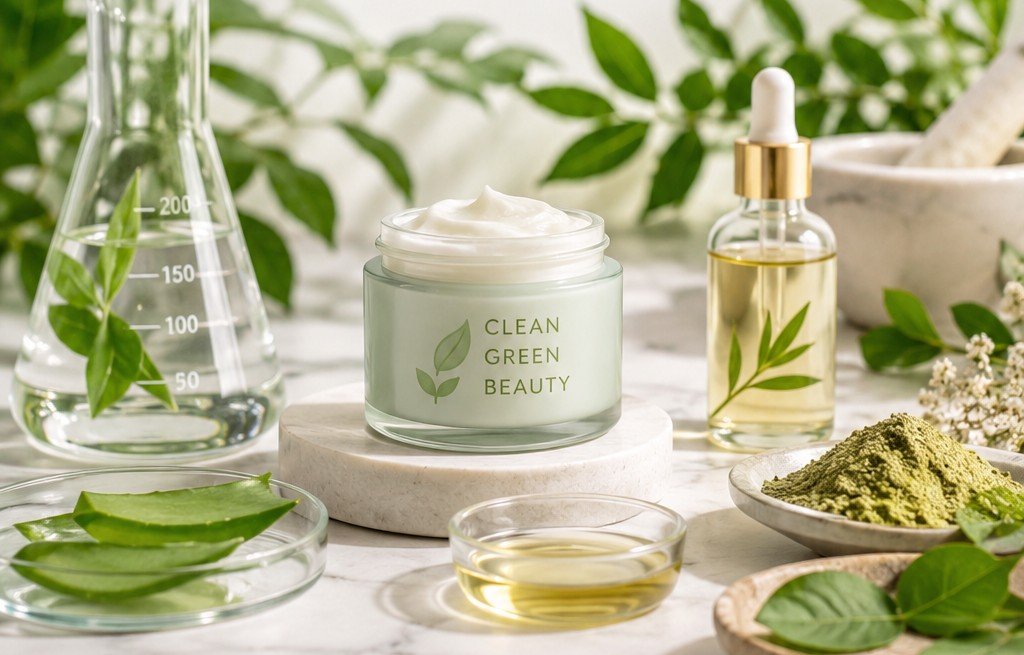
Over the past few years, the words clean, natural, and organic have become some of the most commonly used terms in the cosmetic industry. Almost every new skincare brand wants to position itself as clean, and many consumers believe that if a product says “natural,” it must automatically be safer or better.
As someone who has spent many years developing skincare formulations and helping companies bring products to market, I can tell you that the answer is not nearly that simple.
The reality is that there is no single global definition of “clean beauty.” Different retailers, certification organizations, and even different countries have their own interpretation. Because of that, developing a truly clean or organic product requires much more than replacing a few synthetic ingredients with botanical extracts.
Clean Beauty Starts with Purpose
A clean formulation should first be designed with safety, performance, and transparency in mind.
When I begin developing a new formulation, the first question is never, “How many natural ingredients can we add?” Instead, it is:
What does this product need to accomplish, and how can we achieve that goal using the safest and most appropriate ingredients?
Sometimes that means using naturally derived materials.
Sometimes it means selecting carefully manufactured ingredients that have an excellent safety profile and lower environmental impact.
Good formulation is always based on science, not marketing.
Natural Does Not Always Mean Better
One of the biggest misconceptions I encounter is the belief that natural ingredients are automatically safer than synthetic ones.
Nature produces some wonderful cosmetic ingredients:
- Plant oils
- Botanical extracts
- Natural waxes
- Fermented ingredients
- Natural humectants
- Essential oils
However, nature also produces allergens, irritants, toxins, and unstable compounds.
For example, essential oils can provide beautiful fragrances and skin benefits, but they may also contain naturally occurring allergens that must be declared on cosmetic labels in many regions.
Likewise, certain plant extracts can vary significantly from one harvest to another depending on climate, soil conditions, and extraction methods.
A responsible formulation scientist understands these variables and designs products that are both effective and consistent.
Organic Is More Than an Ingredient List
Many people assume that adding organic Aloe Vera or organic Jojoba oil automatically makes the finished product organic.
Unfortunately, it doesn’t work that way.
Organic certification looks at much more than individual ingredients. Depending on the certification body, requirements often include:
- Approved raw material suppliers
- Traceability of every organic ingredient
- Manufacturing procedures
- Cleaning validation
- Storage and segregation of organic materials
- Documentation and record keeping
- Packaging compliance
- Annual facility inspections
Developing an organic skincare product is as much about manufacturing discipline as it is about formulation.
Without the proper systems in place, even a formula containing mostly organic ingredients may not qualify for certification.
Green Chemistry Plays a Bigger Role Than Many Realize
One area receiving increased attention is green chemistry.
Green chemistry focuses on developing ingredients and manufacturing processes that reduce environmental impact while maintaining product quality and safety.
This includes considerations such as:
- Renewable raw materials
- Energy-efficient manufacturing
- Biodegradable ingredients
- Sustainable sourcing
- Reduced waste generation
- Lower carbon footprint
Many modern cosmetic ingredients are created using green chemistry principles, even if they are not considered “100% natural.”
In many cases, these ingredients perform better, offer greater consistency, and may even have a lower overall environmental impact than some traditionally sourced natural materials.
Preservation Is Often the Most Difficult Decision
One of the most challenging aspects of clean beauty R&D is preservation.
Consumers increasingly request products that are free of Parabens, Formaldehyde donors, Phenoxyethanol, or other commonly used preservatives.
At the same time, no manufacturer should compromise product safety.
A poorly preserved cream or serum can become contaminated with bacteria, yeast, or mold long before its expected shelf life.
Finding the right preservative system often requires balancing:
- Product pH
- Water activity
- Packaging design
- Consumer usage
- Regulatory requirements
- Compatibility with botanical ingredients
There is rarely a single “perfect” preservative. The best choice depends on the complete formulation.
Transparency Builds Trust
Consumers today are more informed than ever.
They read ingredient labels.
They research ingredients online.
They ask difficult questions.
That is a positive change for our industry.
Rather than relying on buzzwords, manufacturers should be transparent about why specific ingredients were selected and what role they play in the formulation.
When customers understand the science behind a product, they are more likely to trust the brand.
Clean Beauty Requires Experience
Developing a successful clean or organic skincare product is rarely a matter of following an online recipe.
Every ingredient influences the behavior of the others.
Changing one emulsifier, replacing one preservative, or substituting one botanical extract can affect:
- Stability
- Texture
- Appearance
- Fragrance
- Shelf life
- Regulatory compliance
- Manufacturing efficiency
That is why formulation development involves repeated laboratory testing, stability studies, microbiological evaluation, and manufacturing trials before a product reaches the market.
Final Thoughts
Clean beauty is not a trend that will disappear. Consumers increasingly want products that are effective, responsibly manufactured, and transparent about their ingredients.
At the same time, true clean formulation should never sacrifice science for marketing claims.
The best products combine carefully selected ingredients, sound formulation principles, responsible manufacturing, and rigorous testing.
Whether the goal is a natural moisturizer, an organic facial oil, or an advanced botanical serum, success comes from balancing performance, safety, sustainability, and regulatory compliance.
In my experience, that balance is what separates a product that simply sounds good on the label from one that consistently performs in the hands of consumers.
Recent Comments